
Health Coaching + Therapy
A collaborative approach to whole person well-being.
Many clients know what supports their well-being, yet struggle to implement it consistently.
They may say:
"I know what I should do, but I can't seem to stick with it."
"I'm exhausted all the time."
"I know exercise would help."
"I want to take better care of myself, but life keeps getting in the way."
Health coaching helps clients bridge the gap between insight and action.

Brandi Montague, NBC-HWC, credentialed through the National Board for Health & Wellness Coaching.

A Collaborative Partnership
To be clear:
I don't diagnose mental health conditions.
I don't provide psychotherapy.
I don't process trauma.
And I’m not a life coach.
My role is to help clients implement sustainable lifestyle behaviors that can improve physical health, resilience, and overall well-being -- and provide health education where appropriate.
Therapy and health coaching are not substitutes. They are complementary tools that can help clients thrive.

Health coaching can reinforce therapeutic work by helping clients:
Improve sleep quality and/or quantity
Refine nutrition and movement
Regulate energy levels
Build stress-management skills
Practice resilience strategies
Establish healthy routines
Increase self-efficacy
Create consistency between therapy sessions
Better physiology often supports better mental health.
Coaching Improves Therapy Outcomes

Instead of simply advising the client to "eat healthier," coaching focuses on practical experimentation, meeting the client where they are. Some possibilities might include:
✓ Food logging to build awareness
✓ Building a new habit of eating breakfast
✓ Starting the day with a protein-rich breakfast
✓ Focusing on balanced meals with proper macronutrients (protein, carbohydrates, and healthy fats) for weight loss and muscle synthesis
✓ Incorporating meal prepping into routine
✓ Be mindful of consistent meal timing
✓ Eating 3 hours before bedtime
✓ Reducing alcohol near bedtime and/or days per week
✓ Tracking sleep patterns and energy levels
✓ Wearing a CGM or Oura Ring for tracking
✓ Improving sleep hygiene
Coaching Support Is Individualized
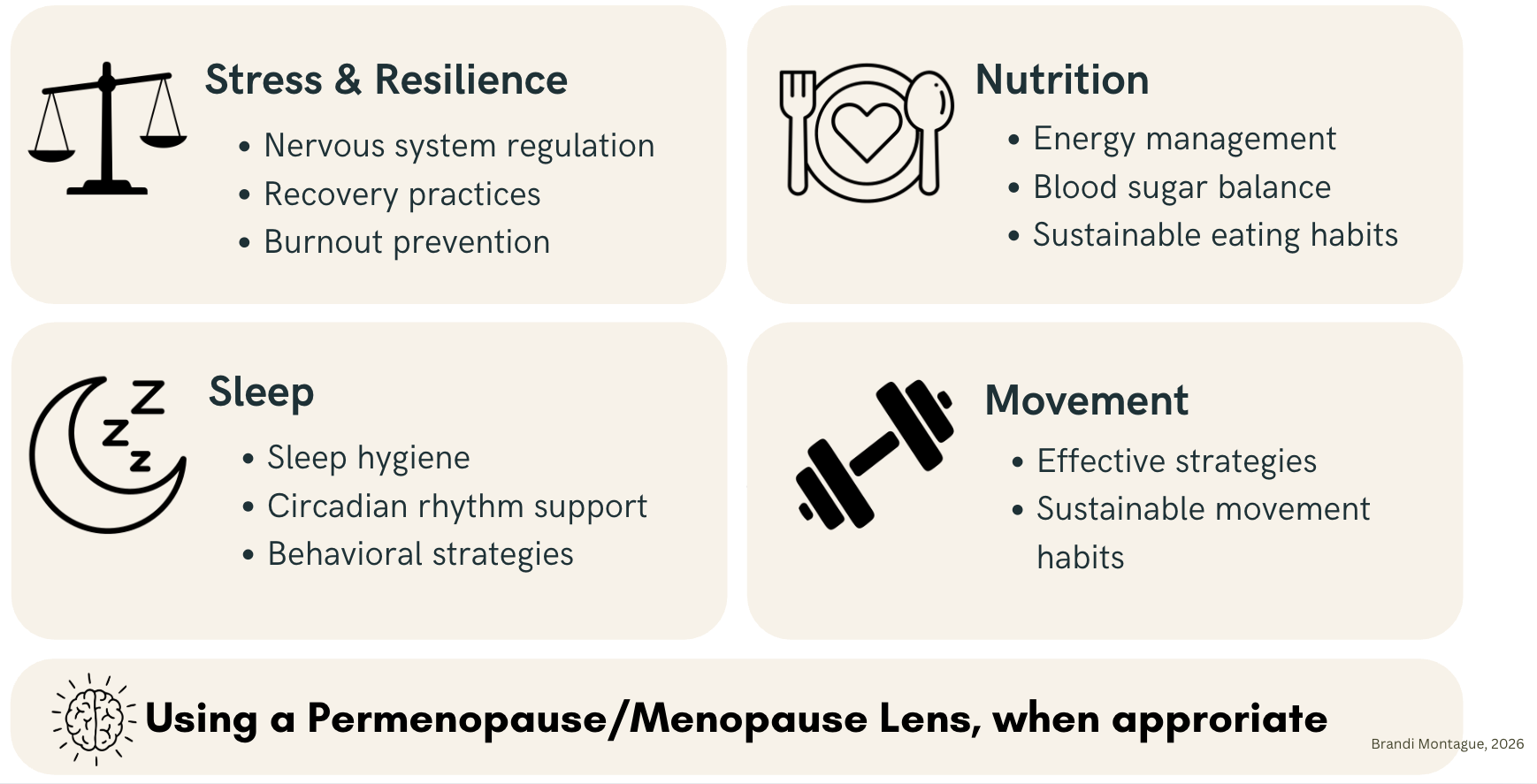
My Areas of Expertise

Clients Who Benefit the Most
Clients who know what to do but struggle with follow-through
High-achieving women experiencing burnout
Women navigating perimenopause or menopause
Clients with chronic stress and poor self-care habits
Individuals working on sleep, nutrition, movement, or resilience goals
Clients on GLP-1 medications looking to lose weight or maintain weight loss
Clients seeking greater accountability between therapy sessions
Therapy + Health Coaching Testimonials

“Eating was my go-to coping mechanism during my stressful divorce and I found myself at 233 pounds. I was considering a GLP-1, but my doctor suggested I work with a coach on the foundations of health first. After my first session with Brandi, she referred me to a therapist. With my therapist I’m working on healthier coping strategies beyond eating. At the same time with Brandi, I’ve learned how many calories, protein and carbs to eat in a day. I’ve starting packing my own lunch, avoiding fast food, and eating healthier snacks at work. And I’m starting to get more steps in. In just 6 weeks I’ve lost 14 pounds. My mood is so much better, my energy is improved and mostly I’m really proud of myself. I feel like I can do this on my own without a GLP-1.”
S.S., age 51
”I initially met with Brandi to help me with my sleep. Brandi suggested I meet with a therapist because I was bringing up stories from my childhood in our coaching sessions. My new therapist introduced me to the concept of complex trauma and it’s helping me understand myself better. And with Brandi I’ve created a Stress Management Toolkit that includes three things I can do every day to help mitigate stress. For me that’s starting my day with a meditation, going to bed by 10p, and daily exercise. My toolkit also outlines what stress feels like in my body and mind. And when I’m feeling like that I use my ‘in the moment’ tools to help alleviate those sensations. For me that’s box breathing, a bike ride, or a call to my sister. I am starting to feel more in control of my anxiety and sleep.”
A.M., age 55

The Ripple Effect
Better Health Habits →
Better Emotional Regulation →
Greater Capacity for Therapeutic Work

About the Practitioner
Brandi Montague is a National Board Certified Health & Wellness Coach (NBC-HWC) credentialed through the National Board for Health & Wellness Coaching. With certifications in Women’s Health Coaching, Perimenopause/Menopause Coaching, Coaching for Patients on GLP-1s, Hormone Masterclass, and Longevity Coaching.
Her work focuses on helping women navigate the metabolic changes that often occur during the years leading up to menopause. Brandi offers structured implementation programs that integrate easy-to-understand metabolic education; nutrition, movement, sleep optimization, and nervous system regulation strategies; and practical lifestyle implementation to help women navigate this stage of life with more clarity and confidence.
She collaborates with therapists to improve client outcomes. Better physiology often supports better mental health.
If your practice works with midlife patients struggling with weight gain, brain fog, energy crashes, low stress resiliency, poor sleep, etc, then structured coaching support may significantly enhance outcomes.
Please reach out for information about my therapy-adjacent programs.